
15 May Leading, Managing and Communicating Well: The Real Drivers of Business Success
If you’re running a small business, you already know that success isn’t just about what you sell – it’s about how well you lead your people, manage your operations and communicate every day.
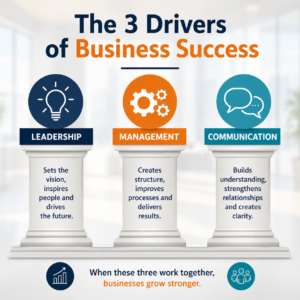 Strong leadership, effective management and clear communication sit at the core of every thriving organisation. Yet many workplaces still struggle to understand the differences between these areas or to develop them with intention. While “leader” and “manager” are often used as interchangeable labels, the value they bring – and the impact they have – is markedly different. When organisations appreciate and strengthen all three, they create environments where people grow, perform and are loyal.
Leaders and managers share a commitment to organisational goals and to supporting the teams around them. They are both responsible for enabling communication, maintaining clarity and helping people navigate challenges. But their approaches diverge: managers keep the business running smoothly, while leaders give the business direction. Both roles are essential – one provides stability, the other drives momentum.
A strong manager is the backbone of daily operations. They ensure systems work, processes are followed and expectations are understood. Research shows that half of employees have left a job purely because of their manager, underlining how influential management behaviour really is. A successful manager doesn’t merely instruct; they remove barriers, create clarity and support people to do their best work. They balance structure with humanity, offering guidance, consistency and reassurance.
Choosing the right managers, therefore, requires more than promoting high performers. It means identifying individuals who show accountability, honesty and a genuine interest in people. These are the managers who build trust, who nurture capability and who understand that their role is less about doing the work themselves and more about enabling others. Organisations that recognise and support these qualities see managers who develop teams rather than simply monitor them.
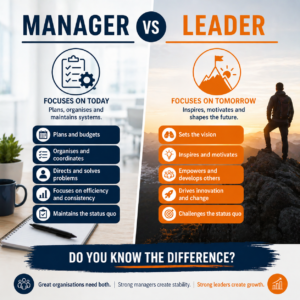 Leadership, meanwhile, is rooted in inspiration, influence and vision. Leaders look beyond the present moment and shape the future direction of the business. They encourage innovation, embrace adaptability and create environments where people feel motivated to grow. Unlike managers, leaders do not rely on positional authority; they inspire followership through credibility and authenticity.
Whether drawing on models like the Tannenbaum–Schmidt continuum, Situational Leadership or Goleman’s well-known leadership styles, the message is consistent: the best leaders adapt. They understand when their team needs structure, when it needs guidance and when it needs freedom. They balance big‑picture thinking with empathy and ensure their team feels both supported and challenged. They initiate change, encourage fresh ideas and focus on long‑term impact rather than short‑term tasks.
Both leadership and management are strengthened significantly by mindset, particularly the growth mindset described by Dr Carol Dweck. In a fast-moving business world, the belief that abilities can be developed is an essential asset. A growth mindset encourages curiosity, resilience and continuous improvement. It allows individuals to see challenges not as threats but as opportunities to learn and refine their approach.
Google’s Project Oxygen famously highlighted that its most successful managers were those who embraced growth‑mindset behaviours. They coached rather than dictated, encouraged ideas, supported personal development and fostered a learning culture. When companies follow this example, they create workplaces where staff feel valued, capable and confident – and performance rises naturally as a result.
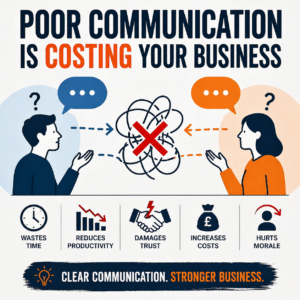 Clear communication is the final pillar and, arguably, the most critical. Poor communication is cited by a significant majority of employees and employers as a primary cause of workplace problems. Misunderstandings waste time, create frustration and erode trust. In many organisations, employees lose substantial time each day simply because instructions are unclear or feedback is inconsistent. Scaled across a workforce, this becomes a costly, yet avoidable problem.
Improving communication doesn’t mean adding more layers or more complexity. It means creating deliberate, accessible pathways that allow information to flow cleanly in both directions. Short, focused check‑ins, simple issue‑raising opportunities and personality or communication profiling can all help. Just as importantly, managers benefit from developing emotional intelligence, self‑awareness and the confidence to give – and receive – feedback constructively. When leaders and managers model clarity, empathy and accountability, teams mirror those behaviours.
Ultimately, leadership, management and communication are not abstract business concepts; they are the daily human practices that determine whether people feel motivated, supported and engaged. Organisations that commit to developing these areas create cultures where performance thrives organically and sustainably.
If your organisation would benefit from strengthening leadership capability, improving management performance or building clearer communication practices, I’d be delighted to talk through what would help most.
 David Legge
Legge‑Work Consultancy Ltd
E: d.legge@legge-work.co.uk
T: 01296 321800
W: legge-work.co.uk
LinkedIn: https://www.linkedin.com/in/david-legge-12867716/
Finding the solution your business needs, together.
We are your strategic partner for
– Business Growth and Development
– Strategic Planning
 – Business Efficiency and Process Management
– Management Coaching
– Restoring Work-Life Balance and
– Returning the enjoyment of running your own business.

Sorry, the comment form is closed at this time.